
 0407 160 107

 View all blog posts

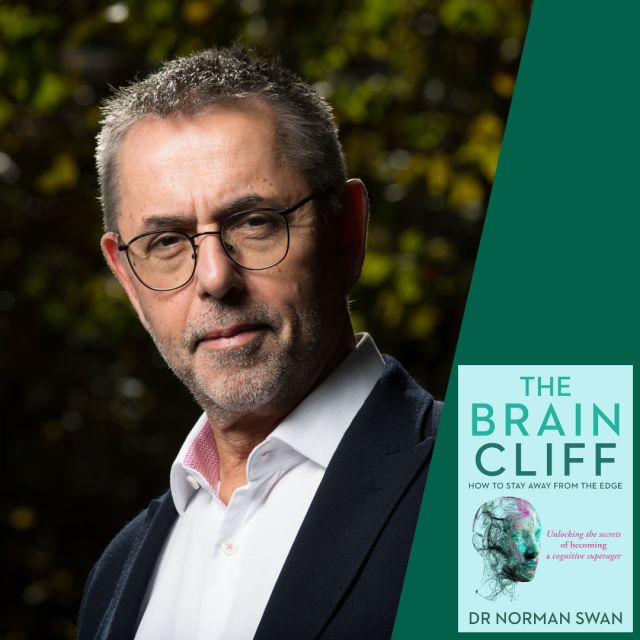
His latest book, The Brain Cliff, tells us how to develop a more resilient and adaptable brain.
Norman argues that in our 40s and 50s we become concerned that our memories aren’t as good as they used to be.
And by our 60s and 70s we worry… “that we are falling helplessly into an abyss which leads to dementia”.
Hence the brain cliff.
If you’ve read even an occasional post here, I trust you’re not feeling helpless and worried that you’re heading for an abyss.
You’ll know there’s plenty we can do to keep a healthy brain, and that it’s not the end of the world, or the edge of the cliff, when we can’t remember someone’s name or where we put the car keys.
I’m not mad about his cliff analogy, but with all the brain books around, a man needs a hook.
A feature of this one is the inclusion of short stories about seven bright-minded people over 90 or 100 who Norman (or his research assistant) interviewed.
‘Cognitive super-agers’
That’s what he calls them and they include a 93-year-old Japanese cleaner who works three hours a day, three days a week in McDonalds, and a 110-year-old Uniting Church minister who retired from full-time work at 84 and stopped playing golf at 95 when he couldn’t climb out of the bunkers.
All seven have a few things in common. They don’t overeat and none carries much abdominal fat. They have breakfast. They’re not smokers and drinkers. They sleep well and do a bit of gentle daily exercise. They retired late or not (completely) at all.
Most have some heart disease — high blood pressure, heart failure, or they’ve had a heart attack — but all are doing well on medication.
Importantly, they don’t let stress get to them.
Their stories show no evidence that they won the genetic lottery and are just plain lucky. And there’s nothing they do that’s beyond most of us, which is heartening.
Think ‘cognitive change’ not ‘cognitive decline’
One thing I like about Norman’s argument is his assertion that we ought to think of our brains as changing over time, rather than declining.
Yes, a 60-year-old brain is different from a 20-year-old brain. Less agile in some respects, but with age we acquire more experience and wisdom. We develop the capacity to contextualise events from our lives, make better sense of them, and see a big picture. Which is something a 20-year-old can’t do.
Building a better brain
He argues that one of the keys to a more resilient and adaptable brain as we get older is ‘scaffolding’.
This refers to reinforcing or enhancing the brain’s capacity so it can adapt and work in new ways. It includes plasticity, i.e. the ability to grow new networks of nerves.
A key part of our brain as far as healthy ageing goes is the prefrontal cortex, the portion that sits behind our forehead.
It’s where our most sophisticated cognitive functions take place, such as paying attention, regulating our emotions, seeing the world from another person’s perspective, planning, decision-making, learning complicated things, bringing together memories, and prioritising.
We can bolster our prefrontal cortex by, for example, learning new skills, meeting new people, and staying aware and engaged. Exercise also contributes by developing new neural pathways.
On the other hand, depression, chronic stress, and substance abuse can reduce our capacity in this area.
An understanding that the prefrontal cortex can be developed or diminished might help to explain why some older people develop intractable views. Everything’s black and white, and their way is the only way.
Similarly, there’s that relative who causes family upsets every Christmas because they can’t read the room. Maybe they never could, but what’s also possible is that as they’ve grown older their ability to manage their emotions and pick up social cues has dropped off.
How else to maximise brain enrichment and minimise depletion
Enrichment factors include:
Purpose. Having a reason to get out of bed is a buffer in hard times.
A good social network. Not necessarily a big one. We need people around us who give as well as take.
Grandparenting. People who look after their grandkids have better cognitive function than those who don’t, he says. And the more grandparenting the better our cognition. I’ll let you be the judge of that, but apparently it’s all good as long as we don’t end up with custody of them. Surprise, surprise, that’s not a recipe for a healthy brain.
Volunteering. It’s an opportunity to learn new skills and meet new people.
The MIND diet. Norman’s keen on this. I wrote about it six months ago.
Quick refresher: MIND stands for Mediterranean-DASH Intervention for Neurodegenerative Delay. (The DASH diet, i.e. Dietary Approaches to Stop Hypertension is low fat, low salt, low sugar.)
The MIND diet is largely plant-based, and nothing wrong with that, but red meat and full fat dairy are categorised as ‘unhealthy’ and to be avoided. Along with pastries and fast food.
You’d want some evidence for that position though, wouldn’t you? You’d need to demonstrate that the MIND diet did in fact delay neurodegeneration and that there was something problematic for the brain about meat or full-fat dairy.
In a three-year trial with just over 600 people (mostly women, average age 70) half were assigned to eating the MIND diet and the other half ate their usual diet, though there was some calorie reduction added to the mix.
Cognitive testing at six months, and one, two and three years showed no difference between the two groups, i.e. No neurodegenerative delay whatsoever.
A healthy (real food) diet matters, but there’s no evidence for the MIND regime and I have no idea what Norman sees here that I don’t.
Exercise. Improves brain plasticity but it’s also important to challenge ourselves. Once something becomes easy it’s time to raise the bar, so to speak.
Vaccination. I’ve written about this too. People who have their shingles, flu and pneumonia shots appear to have less dementia. But we don’t know why.
Of course, any time we don’t get shingles, flu or pneumonia it’s a good thing.
Norman’s heading is ‘Vaccination is great for the brain’. Maybe it is, maybe vaccines boost our immune system, or maybe conscientious people who get vaccinated also take good care of their health.
Not retiring. He says they’ll have to carry him out of the ABC because he has no intention of retiring.
But retirement is complicated. It depends on who we are, how healthy we are, what kind of work we’ve been doing, how well set up we are financially, whether we get to leave work of our own volition, and what we do post-work (hint: sitting on the couch watching Netflix all day mightn’t be ideal for brain building).
And these can deplete our brains:
Smoking
Too much alcohol
Poor sleep. Don’t drink before bed, avoid screens, have a dark room.
Recreational drugs. It’s probably not a shock that cocaine and LSD don’t help.
High cholesterol in middle-age.
Stress. Ruminating. Negative, unproductive thoughts rolling around in our minds aren’t good for our brains. We need to find constructive ways of dealing with worry, regret, or intense self-criticism.
Depression and loneliness.
Taking a lot of medications. The more we take the greater our risk of problems. Since almost 40% of people worldwide take five or more, it’s important to review this with doctors regularly.
Head knocks.
Pollution.
High blood sugar.
Vision and hearing problems.
This doesn’t cover everything he mentions, and a couple of other interesting ones are creatine and cognitive training.
Despite all the talk about creatine being good for older brains, there’s too little evidence to support that.
As for cognitive training programs, most are disappointing, but if we know what we’re looking for we might find one that meets our needs. Just check the evidence.
To sum up, there are plenty of brain books out there, but Norman’s focus on building a more resilient and adaptable brain is different in a useful way. No need for any of us to find ourselves helplessly heading for the abyss.
As a bonus, here’s a link to a video interview with his ABC colleague Geraldine Doogue on ageing. It took place about three months ago and is part of a series being undertaken by the Human Rights Commission.
Photo Source: Brisbane Writers Festival