
 0407 160 107

 View all blog posts

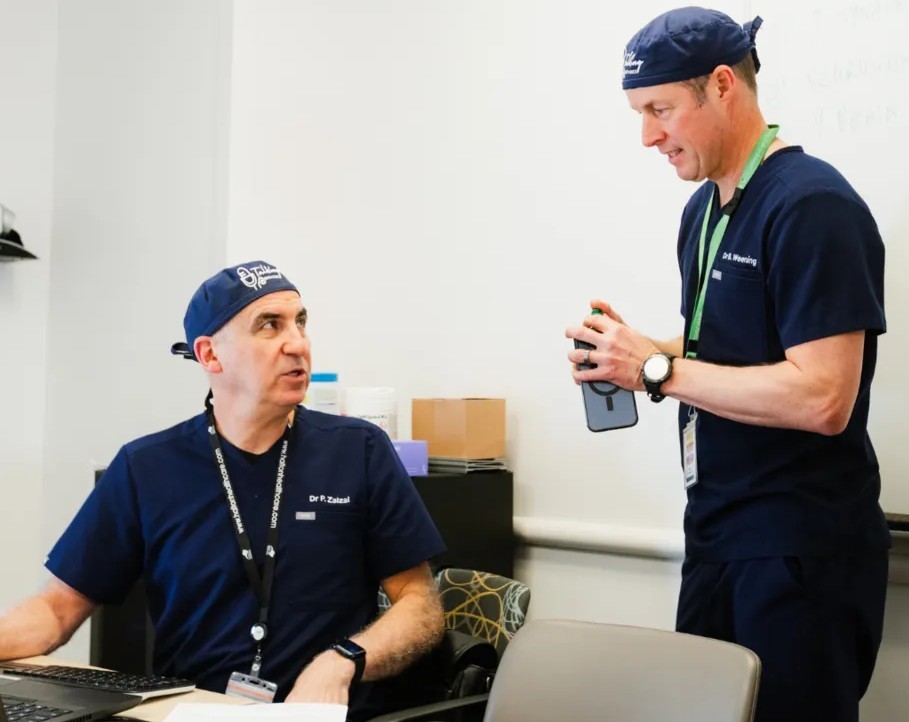
Two Canadian orthopods, a few bad jokes, and their six ‘life-changing’ tips for boosting bone density.
I included a link to this pair a few months ago on another topic, but I’m adding this one because we rarely hear orthopedic surgeons on the topic. They presumably see a lot of older bone up close.
Their names are Brad Weening and Paul Zalzal (that’s them in the photo) and this particular video goes for about 24 minutes.
I doubt the average older woman who monitors her bone density will find the information life changing, but it might at least be a useful reminder.
Here’s a head start on their six tips.
Weight-bearing + impact exercise.
No surprises, right?
As the docs point out, regular walking, terrific though it is, won’t make much difference to bone density. Repetitive, moderate activity is not what grows bone.
Interestingly, they give running a thumbs up. A lot of runners, especially slim-built people, and woman in particular, have low bone mass. In part that’s linked to having a light frame, but again, long, repetitive exercise is not what builds bone. Even though running creates more impact than walking.
They mention racquet sports for impact, and the stop-start nature of these along with changes of direction could give our bones more challenge. The only problem with games like tennis and pickleball is that we assume we can take them on with zero preparation.
This supplies physios with a steady stream of sprains, knee injuries, and tennis or pickleball elbow to treat. Worst case scenario: we fall on a hard surface and break something.
So if your friends invite you for an impromptu game of pickleball, unless you’re reasonably well-conditioned for that, think twice. And if you want to take it up, get yourself prepared.
The docs also talk about hopping, skipping, and jumping. Again, ease into these. A safe and simple way to start impact exercise is to raise our heels then let them land on the floor. Do 10 five times a day (or 20 x3) most days of the week with enough impact to travel up through the legs and hips to the spine.
(Note: that’s not the same as 50 or 60 in a row. We need some stop-start, so do them at different times during the day or with at least a couple of minutes break between sets.)
Fat-soled trainers get a mention too. Do they reduce impact loading? Probably.
My bigger concern, and I imagine a concern of a lot of podiatrists, would be that all that cushioning means the small, internal muscles of the feet don’t have much to do.
These are the muscles that control the movement of our toes, support our arches, absorb shock, detect changes in the surface we’re walking on, and give us feedback about where our body is in space. But if we’re wearing very thick soles those little muscles could be falling asleep.
So if we own these shoes and love them, it’s a good idea to do some regular exercise for the feet — spreading and moving the toes, shortening the foot to work the arches, and so on.
We also need to make sure we don’t trip over stairs and the like because we haven’t judged how high we need to lift our foot when we’re wearing bigger soles.
Resistance training
They emphasise resistance exercise that uses big muscle groups, for example squats, bent over rows, deadlifts, lunges, bench press and overhead press.
These don’t suit everyone, and they acknowledge that. But there are often alternatives or ways to tweak an exercise so it works.
Deadlifts are interesting. They use a lot of muscles, especially our core, back, glutes and hamstrings, but Paul Zalzal expresses some reservation about them because if they’re not done properly people can injure their backs.
That’s true. No one should tackle deadlifts without knowing how to do them correctly, though that goes for all resistance exercises. Having said that about deadlifts, it’s important to learn how to bend and lift safely because we need to do that in everyday life — for example, when we pick up a suitcase or our groceries. A deadlift is a bend and lift.
Nutrition + supplements
The docs’ advice on this is to get our nutrients from food first. Amen.
We need to eat enough food because if we don’t, our bones will suffer. We also need enough protein and calcium.
They’re in Eastern Canada where there’s not much sun in autumn and winter, so they recommend a vitamin D supplement to compensate. Even when we live in a sunnier climate we can be deficient in vitamin D and need a supplement.
They also touch on collagen, magnesium and zinc supplements. Despite suggestions that collagen helps rebuild cartilage, as they point out, it doesn’t. It can contribute to our dietary protein intake, but if we’re eating sufficient protein we don’t also need a collagen supplement.
Magnesium and zinc supplements are only useful if we don’t get enough in our diet.
Avoid what harms your bones
Their main ones are smoking and excess alcohol. One or two drinks a week probably won’t make much difference, they say, but they encourage zero as the ideal. (Nobody really knows the answer to this.)
They also mention caffeine because it can interfere with our absorption of calcium, so it could be wise to separate those two.
Hormone Replacement Therapy
Although they describe this as controversial because there are pluses and minuses in relation to the use of hormone therapy for individual women, there’s evidence that it supports bone density. If we’re over 60 or have osteoporosis though, most doctors will opt for bone medication over hormones. For men with low testosterone there’s also evidence that replacement can support bone.
Bone medications
Some slow the loss of bone, others build it, and they’re very effective. The docs refer to the possibility that taking bisphosphonates (e.g. Fosamax) can cause an atypical fracture in the thigh. It’s rare but it can happen. The development of bone medications has progressed a lot though, and doctors have others to choose from if they have concerns.
In some ways it’s a pity that our main focus on bone is usually its density, because it does a lot more than we give it credit for.
For example, it has a big role to play in metabolism.
In a post a few months ago I wrote about the way muscle ‘talks’ to other organs — the gut, the brain, and so on.
Bone does this too. It’s part of our endocrine system, producing hormones that impact a range of tissues and organs, including our muscles, brain, immune system, blood vessels, pancreas, liver, and kidneys.
Who knew?
But back to the video, it mightn’t be orthopedic rocket science, but it’s a good summary of the key points and we can probably all do with a reminder of those.
Photo Source: Talking with Docs