
 0407 160 107
 View all blog posts
It’s said to benefit our brain, gut and cardiovascular system as well as our muscles and bones, so should we all be taking it?
The online health sphere, especially for peri- and postmenopausal women, seems to be fixated with creatine at the moment.
I wrote about it a couple of years ago when I was first raking through the evidence. I’ll put a link to that article here because it covered some of the basics.
In a nutshell, creatine helps to provide short bursts of energy for high intensity movement. It’s made by our liver and kidneys from amino acids, the best food sources being meat, poultry and seafood.
About 95% of our body’s creatine is stored in our muscle, with the remaining 5% spread across other energy-hungry organs such as the brain, kidneys, gut and heart.
Women’s bodies produce less than men’s, and as we age we also have less, partly because we eat less and partly because older people commonly lose muscle tissue. But supplementation is said to boost our levels by around 20%.
One female researcher has authored a couple of recent papers on the benefits of creatine for women across the lifespan, from menstruation and pregnancy through to post-menopause. On the post-menopausal end of things, the argument is that menopausal estrogen loss contributes to inflammation and oxidative stress as well as a loss of muscle and bone, and that creatine could be a countermeasure to this.
So far, so encouraging.
By mid-2023 I thought I’d followed the research for long enough that it was worth taking to see if I could increase my own muscle and bone.
We’re prone to breaking hips in my family — both my parents and more recently my brother have done that.
In addition, in my younger years I was a distance runner, which means I’m not overly endowed with muscle. I’ve trained with weights for my entire adult life, but if creatine could help add muscle and improve bone, on top of the hormone therapy I already use for that purpose, I was keen.
My interest was piqued by the work of a Canadian researcher who had post-menopausal women do resistance training over two years. Some took creatine and some took a placebo. He concluded that although there was no improvement in bone density, the bones of the women who took creatine became stronger and more resilient.
A particularly effusive advocate of creatine for women describes it as one of the most well-researched, effective and female-relevant supplements available.
She says, “there are very few supplements I recommend across the board. Creatine is one of them.”
On a recent podcast that’s popular with women she asserted that if we take it “we see that everything improves: our brain health improves, our gut health improves, cardiovascular problems start to dissipate, and we have better muscle function.”
We need just a small daily dose of 3-5 grams or half a teaspoon, she said. “It takes about three weeks to saturate the body. And after that you’re like wow, why have I not been taking this?”
Apologies for being a wet blanket, but I’ve been taking a whole teaspoon a day (5 grams) for three years, and I’m not yet in a wow state of mind about the benefits.
I’ve also been ploughing through the recent research and finding it hard to be convinced, at this stage at least, that everything improves with creatine.
So let’s walk through what studies tell us about brain health, gut health, cardiovascular health and what it does for muscle and bone.
Brain health
Since brains need a lot of energy it’s been proposed that creatine could help to treat conditions in which brain energy is low. These include Alzheimer’s, Parkinson’s, Huntington’s disease, psychosis, bipolar disorder and schizophrenia.
And in a time when many people are dealing with mental health issues around anxiety, depression and PTSD, any difference creatine can make would be hugely welcome.
Mild traumatic brain injury is another area being looked at.
But to date the best we can say about any of these applications is that creatine could be promising. The research hasn’t yielded much that’s conclusive.
Most of the studies that show benefit have been on younger people dealing with conditions such as sleep deprivation or mental fatigue. So maybe it has implications for, say, shift workers, soldiers, or people with post-viral fatigue.
Of course, older people are probably interested in whether it can tune up our cognitive function. Only two studies have looked at ageing brains. One found that it helped and the other showed no effect.
We don’t know a lot about age-related changes in brain creatine, and a grey area with these studies is that we also don’t know how much creatine the participants get in their diets before supplementation.
For that matter, are we even sure that supplementation increases the brain’s creatine content?
While it’s widely claimed that it does, a recent review of the research in this area argued that there’s not much evidence to support this.
It concluded that “the current body of literature is small, incohesive, and critical knowledge gaps remain”.
Gut health
Studies here are looking at whether creatine’s energetic, antioxidant and anti-inflammatory properties could aid in the treatment of inflammatory bowel diseases such as Crohn’s disease and ulcerative colitis. It’s still early days, but like the brain research it could be promising.
Cardiovascular health
A few short-term studies have looked at creatine and heart failure. Heart failure patients typically have muscle weakness and find physical exertion hard, so extra energy could help
The results are about half and half, but some suggest it might increase patients’ capacity for physical activity. Similar work is looking at a possible role in stroke rehab.
Much of the research on creatine and heart health has focused on young, healthy people with no cardiovascular issues, though one study with older men aged 55-80 using a relatively big dose (20 grams per day) concluded that it had a positive effect on the health of their arteries. But it was very small and only carried out for a week.
Again, a long way to go before we can make meaningful claims.
Muscle
Creatine should give us the energy to train harder and recover faster. Which, in theory, should translate into greater strength and a bit more muscle for people doing resistance training.
After I’d used it for about four months I thought I’d keep going because I was lifting a bit more than I had been. But over a longer period, I’ve concluded that I lift more when I’m focused on doing that, i.e. it’s intentionality and mindset rather than creatine.
As for the energy to train, a decent sleep makes the most difference there. I probably also have a bit more get-up-and-go on Mondays compared with Fridays.
So after three years I can’t sheet much home to creatine. If it’s made a difference, it’s been too subtle to notice.
A New York based exercise scientist who’s written umpteen books on building muscle argues that creatine doesn’t make a difference for everyone. The folk most likely to see a change are vegans and vegetarians, given they’re not eating red meat, poultry or fish.
In addition, some people genetically don’t respond to it.
A few years ago he rounded up a research team to comb through the studies on creatine and muscle growth.
They concluded that while supplementation was beneficial compared to a placebo, that benefit was small, especially for older people. “… older adults do not appear to achieve much of a muscle-building benefit from supplementation”.
He says that 95% of the benefit to our muscles will come from exercise, nutrition, and recovery (rest and sleep), and that creatine might be the cherry on top, at least for younger people. That’d be my assessment too.
Bone
Going back to the Canadian research on postmenopausal women and bone that prompted me to give supplementation a go, I recently heard a member of that team reflecting on the study.
He said the results “weren’t profound”. Shame I hadn’t heard him say that three years ago. In retrospect I was a tad too optimistic.
Along with supervised resistance training, the women in that study also used a dose that was at least twice what I’ve used. A small detail I’d forgotten.
These days, maintenance can be as good as it gets in the bone department, though I admit that when I fronted up in April for my first bone density scan in four years, I was quietly hoping for a little bonus, given I’d diligently taken this stuff for so long. There wasn’t one. Sigh.
And even maintenance I put down to work in the gym rather than creatine.
The upshot
I’m not saying creatine doesn’t do what it’s supposed to do, but maybe it does it better for younger people than older people. Maybe if I had a more muscular body type. Maybe if I was vegan…
It seems to have application when people are sleep deprived and/or mentally fatigued, and if even a fraction of the possible benefits in relation to brain, gut and heart conditions do come to fruition it’ll be something to celebrate.
It’s true that there’s been a lot of research on creatine, but we also have a long way to go before we can declare that all women should take it. When it comes to women over 60, there’s plenty of endorsement, just not a lot of hard evidence.
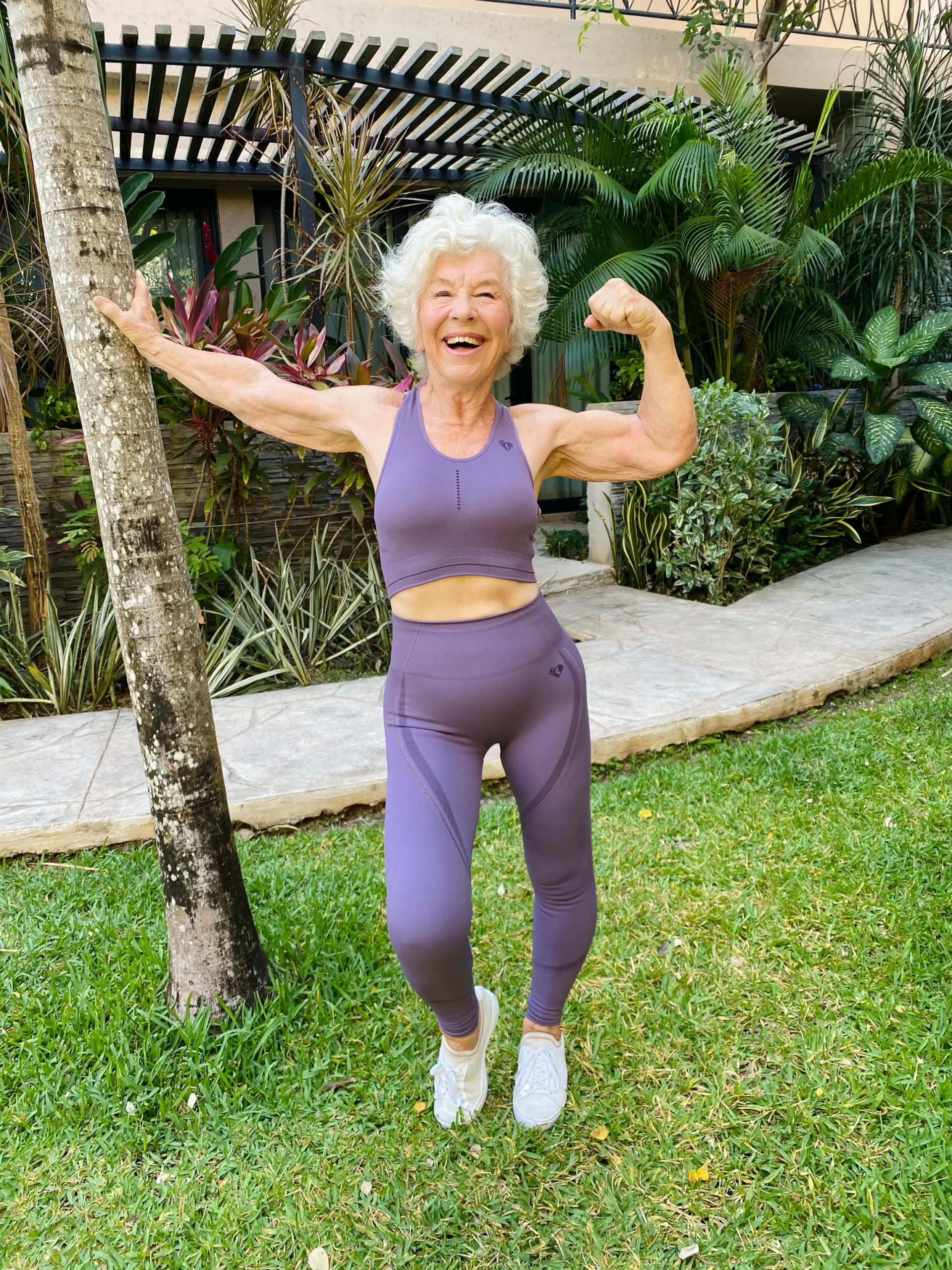
Still, it’s a space worth watching. As much as I can’t see the proof that we’ll see our brains, guts, hearts and muscles improve, when I was looking for a photo I came across this one of Canadian fitness influencer Joan MacDonald. Joan’s pretty famous. She’s also 80. And she takes creatine.
(Just a heads-up that if you do decide to try creatine it will raise your creatinine level when you do a generic blood test. High creatinine is considered an indicator that your kidney function is down. Although creatine doesn’t impair kidney function — research has shown us that much — it can look that way. So it’s a good idea to stop taking it for a couple of weeks before your blood test. Be warned too that some GPs aren’t keen on patients using creatine for this reason.)
Photo Source: Joan MacDonald