
 0407 160 107
 View all blog posts
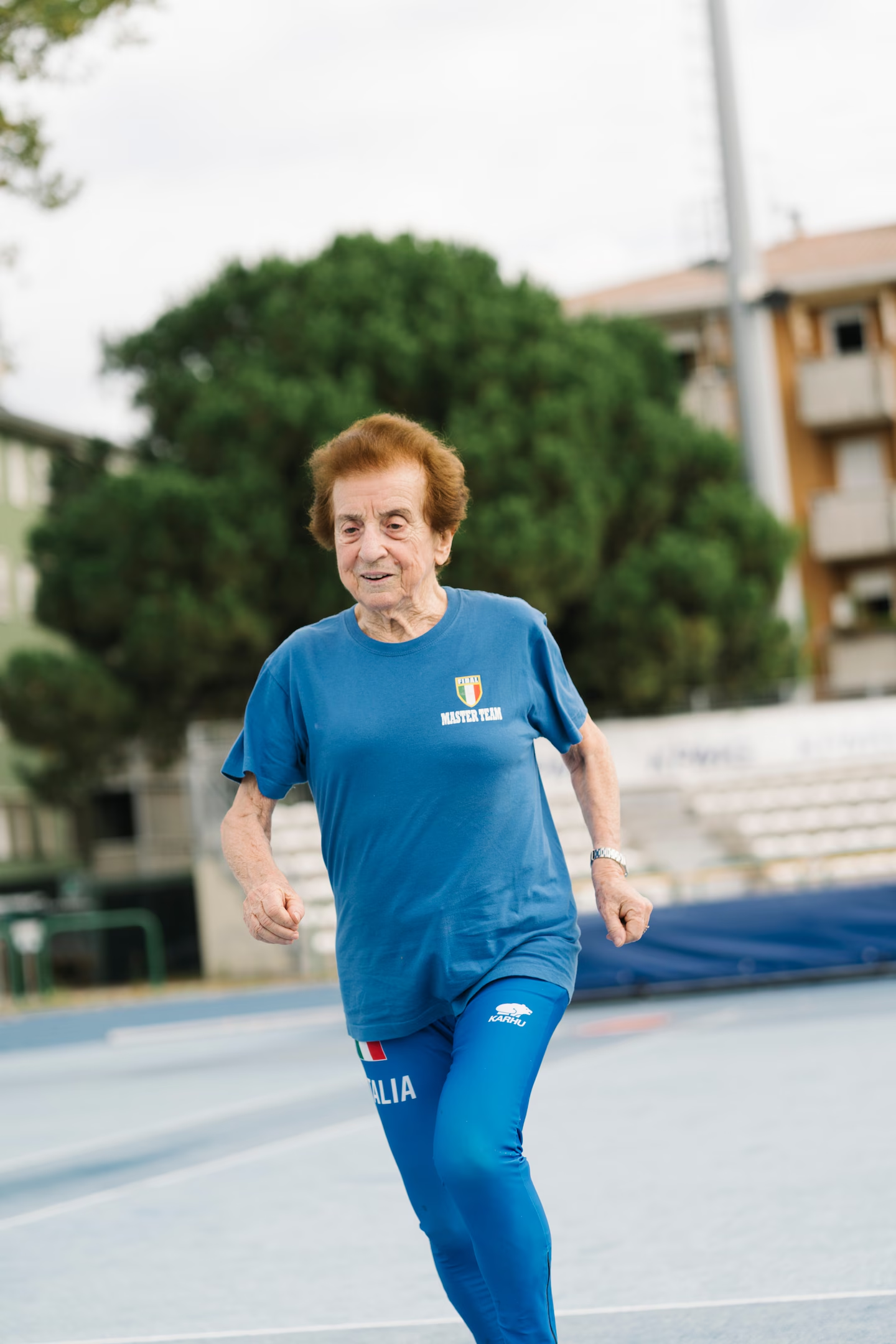
She’s a world record holder, but the take-home message from Emma Mazzenga’s efforts is not about being a champion runner.
In the last couple of years Emma’s attracted attention around the world as she’s mowed through age group records in the indoor 60-, 200- and 400-metres, and the outdoor 200-metres.
But she’s largely just doing what she’s done for much of her life. She started sprinting as a young biology student at the University of Padua, and although she stopped when work and family took over, she kept hiking and skiing.
At age 53, presumably when the kids were off her hands, she picked it up again and hasn’t stopped. These days she trains three times a week, still in Padua, along with walking and lifting light weights.
You can see her in action in this CNN footage. She’s not quite 155cms but she scoots along.
Scientists have understandably been keen to put Emma through a range of lab tests to see what her body can teach them about ageing.
Here’s some of what they’ve learned:
Her mitochondria behave like those of a 20-year-old.
Mitochondria are the energy producing part of our cells. The more of them we have and the bigger they are, the more energy we can generate.
It so happens that mitochondria respond well to sprinting, so Emma’s excelling here.
The communication between her nervous system and her muscles is outstanding.
All movement requires these two to talk to each other, but since running also requires a lot of coordination, this communication has to go up a notch. Consistent exercise seems to help nerves and muscles to keep working together well.
Her muscle fibres aren’t doing what we’d expect though.
Our muscles contain both fast and slow twitch fibres. Sprinting uses the faster ones, while endurance activities develop the slower ones. As we get older, it’s common to lose both size and number of the fast ones.
Emma has a lot of fast twitch fibres. Size-wise, they’re what might be expected in a woman in her late 70s to early 80s — good for a 92-year-old but not remarkable.
The surprise is her slow twitch fibres. They look like those of women in their 20s. This has the scientists scratching their heads and wondering if the slow twitch fibres have developed to counter her loss of fast twitch fibre size, but no one knows.
In May I caught up with a man I’ve known for a long time who’s similar to Emma in that he’s also a world-record holder — in indoor rowing over 1000 and 2000 meters. He turned 99 this month.
Like her, he’s also been physically active across his entire life. In addition to training on his rowing machine, he’s a keen golfer and has long been a good ballroom dancer. He exercises at a gym and walks his cavoodle a couple of times a day.
He’s had one knee replaced and is trying to convince his surgeon to do the other one.
So what powers these nonagenarians? Genes? Lifestyle? Personality? Luck that they can still move as well as they do? Salami sandwiches and pasta in Emma’s case?
The other 99.9% of us won’t be world record holders and won’t be too disappointed about that. But records aren’t the point.
This pair, impressive though they are, are more than anything else a demonstration of the benefits of regular lifelong movement.
Either, at some stage, could have decided that if they were only going to go downhill in the future, what was the point? Instead, they’ve kept going and have been purposeful about it.
Some of you might be familiar with Peter Attia. He’s a Canadian who lives in Texas. He has a medical background, wrote a book on longevity, and hosts a podcast.
He came to prominence earlier this year when the US Department of Justice released his email exchanges with Jeffrey Epstein, but that aside, one thing he does deserve credit for is his argument that we need to train for old age.
Many of us will live long lives, and if we want to do the things we do now when we’re 90, we’d better prepare.
That goal mightn’t be sprinting, but it could be carrying our groceries upstairs, doing the washing, gardening, playing golf or walking the dog.
And even though there’ll be things we can’t physically do, the key is finding what we can do and doing it consistently.
Maybe we need an overhaul of Nike’s old Just Do It slogan. It might be time for Just Keep Going.
Photo Source: Washington Post