
 0407 160 107
 View all blog posts
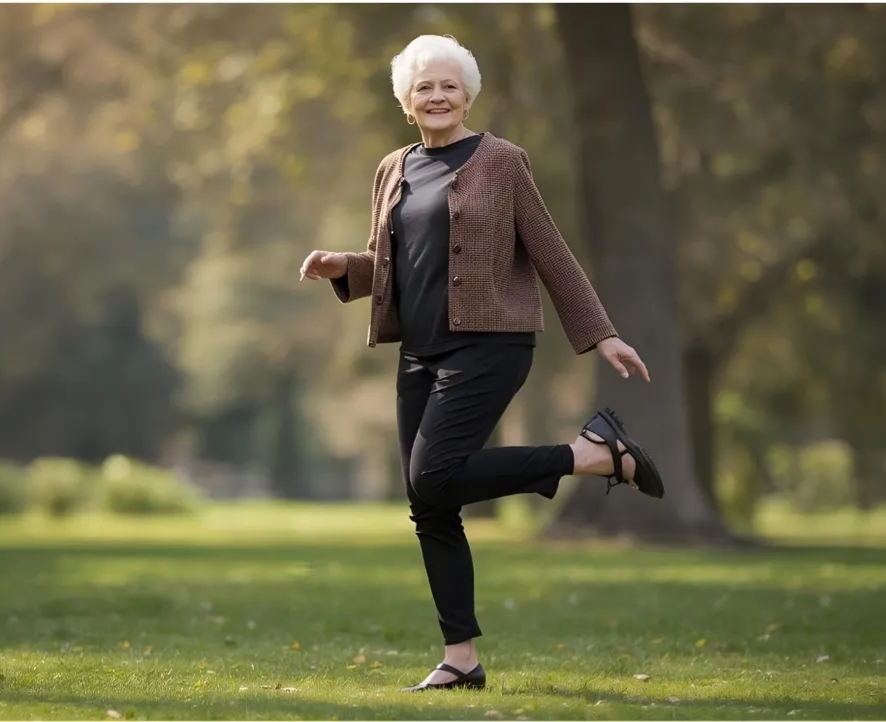
We know we lose it as we get older and need to practice. But once we can stand on one leg, then what?
Hold on, what if we struggle on one leg?
Getting started
If that’s the case, go back to first base and try a split stance, with one foot in front of the other, as though you’re walking, but with both feet flat on the ground. Not in a straight line, just normal hip width apart.
Be sure to have a wall, a kitchen benchtop, a railing, or the back of a sturdy chair at the ready whenever you practice. You want reliable support at your fingertips.
See if you can hold the split stance with either foot in front for at least 10 seconds. If you need support, practice it that way, and slowly wean yourself off it. At first, you might need to hold on with your whole hand but eventually use just a finger, then nothing. It takes as long as it takes.
If the split stance feels secure, try a heel-toe position, with the heel of the front foot against the toe of your back foot. This time it’s as though you’re standing on a straight line.
Once you can do that for 10 or 15 seconds you’re probably ready for one leg. Alternatively, you could up the ante with the heel-toe position by holding for 30 seconds, closing your eyes a fraction, tossing a small ball from hand to hand, or turning your head to look from side to side — but not all at once, not initially anyway ;).
If you try one leg and can’t manage 10 seconds keep practicing until you can, building up in tiny increments. No one likes feeling wobbly, but have your wobbles spur you on to improve rather than being an excuse to quit.
Once you can do 10 seconds on each leg, aim to work up to 30, and maybe try some of the variations listed above — closing your eyes a fraction, and so on. Looking side to side is more advanced so leave that one until you’re reasonably confident.
Should you practice in shoes or bare feet? Depends on your feet and what you do most often, but if you don’t wear shoes around the house, do some practice that way. (Though as the photo shows, if you have this balance thing licked you can stand on one leg on the grass in your dress shoes.)
If you have issues with your feet or other reasons why standing on one leg is difficult, just do your best and work at the other aspects of dealing with the balance challenges of daily life.
Mastering everyday situations
Those daily life challenges can include carrying things up and down stairs,
walking around or over obstacles with a load in our arms or hands, reaching while leaning forward, or picking up something moderately heavy from the floor with one hand. Even standing up from a low seat can take something.
The key is to identify situations you find difficult, or at least don’t feel sure about, and practice those.
All require a level of strength as well as stability. If we’ve had an extended period of inactivity, our strength will probably be down. That calls for an exercise program to get back to square one. This might include movements such glute bridges and standing up repeatedly from a sitting position without using our hands.
Staying stable relies on the deep muscles of our spine, pelvis and torso working to hold us in place (i.e. core stability). We can’t stand on one leg, bend forward and pick things up, or carry something heavy without it.
A common core stability exercise is the bird dog: we’re on all-fours, and we extend one arm forward and the opposite leg behind. It’s our core muscles that hold us in place so we don’t fall over.
Another aspect of stability is being grounded through our feet. When we lean forward we need our weight in our heels; if it’s in our toes we’ll be at risk of toppling.
Practicing to handle the unpredictable
We can be prone to falling when something unexpected happens, which is why it’s useful to train ourselves to deal with more than static balance or everyday bending, lifting and carrying. More complex activities also force us to pay attention.
For example, we might try:
- Standing on or walking over uneven surfaces (e.g. single leg or heel-toe balance on a foam pad or other wobbly balance equipment. At home this could be standing on or stepping on and off a pillow.)
- Walking backwards or heel-toe, or grapevine step (ask Google if you don’t know what that is.)
- Standing on one leg and moving the other one (e.g. using it to tap your toe on objects around you, pointing it in different directions, or writing words or numbers with it).
- Doing two things at once, e.g. reciting the alphabet backwards while walking heel-toe.
- Quick changes of direction. If you go to dance classes or play tennis you’ll probably be good at this already.
There’s a genetic element to balance and some of us have a harder time knowing where our body is in space. People in that category take longer to master the basics, so be patient, keep at it, and progressively work on your core stability and general strength too.
There are clearly lots of ways to improve balance. If you have a friend who also wants to do this, get together and challenge yourselves. Safely.
Of course, to avoid falling it also helps to make smart decisions when you’re out and about.
A few weeks ago, my 66-year-old brother went to the beach with friends. They could have reached the water via a sandy access or a rocky one. They chose the rocks. I know. He slipped on a mossy one and is now doing rehab with his new titanium hip.
So they’re the three keys: practice, pay attention, and don’t do stupid things.
Photo Source: The Note Ninjas