
 0407 160 107
 View all blog posts
A recent study of more than 11,000 people aged 65 and over says yes, and it often does.
This was the work of Yale University’s Professor Becca Levy and her colleague, Dr Martin Slade. Professor Levy’s focus is on the way our thinking affects our health as we age.
The pair analysed more than a decade’s worth of data from the US Health and Retirement Study. This government-funded study is conducted by the University of Michigan, and information is collected from participants every two years. It began in 1992 and is still going.
Levy and Slade found that over time almost half (45%) of the participants showed measurable improvements in physical or cognitive function or both. People with a deficit of some kind recovered and some who started at normal levels of functioning lifted their performance.
Walking speed was used as a measure of physical function because it’s linked to disability, hospitalisation, and risk of dying.
Cognition was assessed with a global test that covered a range of areas including maths skills and short-term memory.
Interestingly, improvements were more likely to occur in participants who had a more positive view of ageing.
This reinforced Levy’s earlier work which showed that people who had positive ideas about ageing were more likely to have good health and live longer.
These improved results go against the widespread expectation that as we get older we just deteriorate.
For example, a 2024 international survey found that 65% of health care professionals and 80% of the general population believed that dementia is a normal part of ageing. It’s not.
Levy and Slade pointed to American endurance swimmer Diana Nyad as someone who’s gotten better with age.
Twelve years ago, at age 64, she swam 177 kms (110 miles) from Cuba to Florida, becoming the first person to do it without a shark cage. It was her fifth attempt over 35 years and it took 53 hours. That’s about two-and-a-half days of swimming.
She finished with a swollen face after being badly stung by box jellyfish but declared she was in the prime of her life. At 64.
She now says she’s better at 76 than she was then. And who’d argue? She’s a formidable character — smart, courageous, feisty, disciplined, determined.
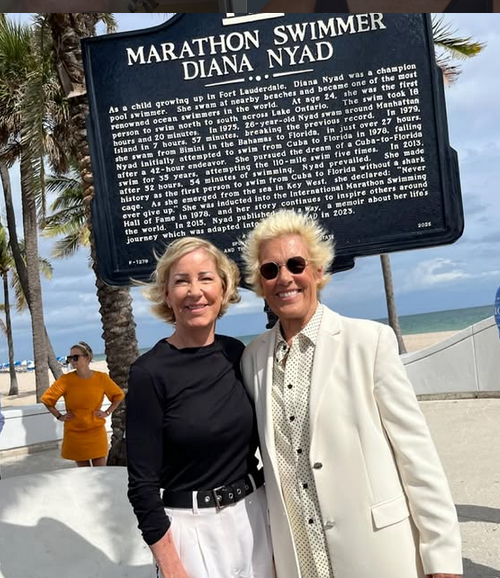
That’s her in the photo, with her friend Chris Evert, after a plaque was erected in her honour in Fort Lauderdale, Florida late last year.
A couple of months ago she told actor Julia Louis Dreyfus on the latter’s podcast Wiser Than Me that “Right now at 76 I feel as strong, as fit, as agile, as energetic as I ever have in my life. Maybe if you and I talk in 10 years, 20 years, I’ll say: Oh, things have slowed down. But at 76 they have not slowed down.”
Julia tells her she’s lucky.
“No,” she says clearly, “it’s not luck. I’ve worked at getting to feel this good.”
Too often, when an older person does something that runs counter to the decline they’re expected to show, we label them as exceptional.
Diana Nyad is exceptional though. I’m not going to tell you how many burpees she does in her Tuesday and Friday training sessions, because your eyes would just glaze over. Suffice to say that if she was 26, it’d still be ridiculous.
Still, she’s mortal. She admits to “getting a little teetery” going down a steep set of stairs and says she needs to do more balance practice. But she’s also proof that some things don’t drop off with age.
Becca Levy’s findings are reminiscent of Professor Ellen Langer’s.
Langer’s the person who, in 1979, had a group of men in their late 70s and early 80s spend a week in a monastery that had been retrofitted to appear as though time had gone backwards and it was 20 years earlier.
She points out that these men were old in the way they presented. But for seven days they were to act and speak as though it was 1959 and they were 20 years younger.
In just a few days they showed improvements in vision, hearing, IQ, and strength. They walked better and stood taller. Without any medical intervention.
They weren’t exceptional. Like the participants in the US Health and Retirement Study, they were just regular people, but in this case they’d shifted their mindset.
Ellen Langer is 78 and still conducting research to show that our thoughts and our bodily function are inseparable. “When we believe everything will fall apart,” she says, “we set ourselves up for everything to fall apart.” The opposite is true too.
But let’s give the last word to Becca Levy.
She says: “What we found is that improvement in later life is not rare, it’s common, and it should be included in our understanding of the ageing process.”
Photo Source: Diana Nyad, on Instagram